Announcing the aep-2026 Release
The Coordination Challenge
Section titled “The Coordination Challenge”Building software is a team sport, but keeping everyone on the same page is hard. When every team has to invent their own API patterns — deciding how pagination works, or how to format errors — we end up with a lot of wasted effort and systems that don’t quite fit together. This isn’t just about having “standards”. It’s about ensuring that users and tools don’t have to continuously relearn the same standards.
A Shared Standard and Tools
Section titled “A Shared Standard and Tools”The aep-2026 edition is our answer to that friction. It is an opinionated API design specification, providing well-defined requirements around common REST concepts like CRUD standard methods, pagination, filtering, and more. By agreeing on these common patterns, we make it easier for services to talk to each other, clients to be built, and for developers to move between projects without needing to learn idiosyncratic conventions.
AEP (API Enhancement Proposals) is an open-source, “anti-bike shedding” kit. It answers the routine questions so we can all focus on the interesting ones. It’s about a shared foundation that lifts everyone up and lets everyone build on the same tooling platform.
Stability for Builders
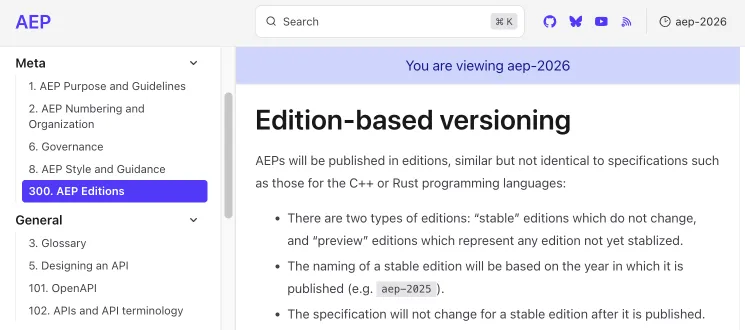
Section titled “Stability for Builders”To build lasting tools, you need a solid foundation. You can’t build tooling on top of a spec that changes regularly. The aep-2026 edition is a major milestone because we are introducing a stable version of the specification and establishing a release cadence with AEP-300. This decouples stability for consumers and evolving our best practices:
- For Builders: Invest in linters, libraries, and other tools today knowing they will keep working for years.
- For the Future: We can keep discussing new improvements for the next edition (AEP-2028) without breaking the tools you rely on right now.
The tooling is guaranteed to be compatible for the three most recent editions of AEPs, effectively a 6 year stability cycle based on our current 2-year cadence.
The Tooling Ecosystem
Section titled “The Tooling Ecosystem”Because the standard is now stable, we can share a set of tools that help everyone do less grunt work. The 2026 edition launches with a compatible ecosystem ready for you to use:
- Infrastructure: A Terraform Provider to handle the deployment details.
- Integration: An MCP Server to let AI agents understand your APIs out of the box.
- Exploration: An Interactive Web UI to make daily development smoother.
- Speed: A CLI to quickly call an AEP-compatible service.
Next Steps
Section titled “Next Steps”Come see what we’ve built. Whether you use the whole platform or just grab a few good ideas, you are welcome here.
- Explore: Check out the Tools Page to see what’s available or visit the aep.dev site to review the numbered rules.
- Join: Drop into a weekly Friday meeting or hop into our #aep Slack channel in the CNCF Slack to ask questions or say hello.
Contributors
Section titled “Contributors”This release is the result of years of work and feedback from the community. Special thanks to Richard Frankel, Marsh Gardiner, Yusuke Tsutsumi, Alex Stephen, and Mike Kistler for their stewardship as maintainers on this release. We are also grateful to the growing community of contributors, including David Gagne, Olivier Cano, Oscar Söderlund, and others!